How AI search decides which business to recommend
People now ask ChatGPT, Perplexity and Google’s AI Overviews for “the best dentist near me” or “a web developer for a booking site”, and get a short list of names. AI search is not magic. It is reading your website and everything else about you, and picking the clearest, most trusted answer. It is the part of SEO that changed most in the last two years, and most small business websites are not ready for it.
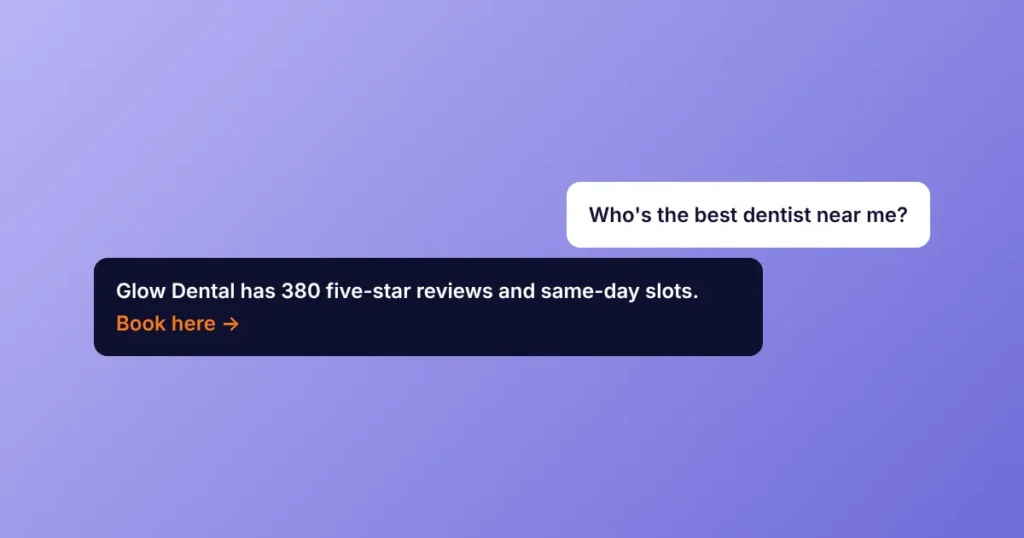
How AI search reads your website
AI tools pull from search results and from pages their crawlers can reach. If your services, prices, location and reviews are hidden in images, sliders or PDFs, the model simply cannot use them. Plain text on fast pages wins. Speed matters here too: crawlers have limited time per site, and slow pages get read less often. Server-rendered HTML is safest, because some crawlers do not run JavaScript at all.
AI search vs traditional SEO
Traditional SEO tries to rank a page in a list of ten blue links. AI search optimization tries to get your business named inside the answer itself. The foundations are the same: crawlable pages, useful content and links from trusted sites. But AI answers reward clarity even more. A page that answers one question plainly is easier to quote than a page that talks around it. Some people call this generative engine optimization, or GEO.
Five things that get you recommended
- Clear answers. A FAQ that answers real questions in one or two sentences each is exactly the shape AI answers take.
- Structured data. Schema for your business, services and FAQs tells machines what each piece of text means.
- Consistent details everywhere. The same name, services and contact details on your site, Google profile and directories.
- Reviews in your own words. Real client quotes on your site, not just stars on another platform.
- Crawlers allowed. Check that robots.txt does not block GPTBot, ClaudeBot or PerplexityBot by accident.
How ChatGPT recommendations work
ChatGPT recommendations come from two places: what the model learned in training, and live web results it fetches when it searches. You cannot change the first quickly, but you can influence the second today. When it searches, it reads the top results and picks the sources that answer the question most directly. Being on page one for the question, with a clear answer on the page, is still the surest route in. Mentions on other trusted sites, like industry directories, local news or partner websites, add to that trust over time.
Schema that helps AI search
Structured data is a short block of code, invisible to visitors, that labels what your page is about. The types that matter most for a small business are Organization or Person (who you are), LocalBusiness (where you are and when you are open), Service (what you sell), FAQPage (your questions and answers) and Review. The full list lives on schema.org. Test yours with Google’s Rich Results Test after adding it, because a typo can make the whole block invalid.
How to check what AI search says about you
- Ask ChatGPT, Perplexity and Gemini the question your customers would ask, like “best boxing gym in my area”, and note who comes up.
- Ask about your business by name, and check whether the services, prices and location they repeat are correct.
- Search the same question on Google and look at the AI Overview at the top, and which sites it cites.
- Repeat once a month. Answers change as your site and your mentions elsewhere change.
The sites these tools cite are the ones to learn from. Look at how they structure their pages, what questions they answer and where else they are mentioned.
What not to do
Do not stuff pages with keywords or generate hundreds of thin pages. AI systems are built to spot that, and they favour sources that read like a person who knows the subject wrote them. Fake reviews are worse still: they get spotted, and they can get your Google profile suspended.
Ask an AI tool about your own business today. What it gets wrong tells you exactly what your website is missing.
Where to start with AI search
Start with the basics that also help ordinary SEO: fast pages, a proper FAQ, schema and consistent profiles. They compound. Following Google’s guidance on AI features is a sensible baseline, and a developer can add the structured data in an afternoon.
AI search optimization is part of the SEO and AI search service, or ask a question about your own site. Speed is part of it too: here is why a WordPress site is slow and how to fix it.